A Highly Energy-Efficient Hyperdimensional Computing Processor for Biosignal Classification
总结
应用了已经提出的方法对 HDC 硬件的设计进行优化,包括 CA Vector folding,并且评估了不同参数对性能、功耗的影响。 应用:生物信号分类。
CA 实时生成超向量,替代了传统的存储内存,提高能效。 在最大吞吐量下,架构实现了10.7倍的改进,每个通道33.5倍。 还设计了一个优化的 SVM 作为对比,HDC在能量效率上比SVM高出9.5倍。
A Programmable Hyper-Dimensional Processor Architecture for Human-Centric IoT
可编程的 HDC 处理器 对 HDC 的操作进行了总结,本文采用 MAP
基准:用了多个例子,建立了 HDC 和传统 ML 算法的对比,在 CPU / GPU 上
- 结构:有一定扩展性 分析数据流: 两种核心模式: n-gram; feature superposition 主要成分: IM/Encode/ AM 根据数据流,设计了基本单元,然后构成层次
其他方法: 特征降维(feature reduction)或特征选择(feature selection)
A Robust and Energy-Efficient Classifier Using Brain-Inspired Hyperdimensional Computing
HDC 展示得与脑行为一致。它式高维、全息、伪随机的向量。高能效的计算容忍硬件故障。
方法:基于超维分类的硬件。超高准确率,略低于传统机器学习方法,只需一半的能量。此外可以容忍 8.8 倍的存储单元错误,保持高准确率。 应用:21种欧洲语言数据集 用于高维分类器,包括编码和相似性搜索两个主要模块。 总体算法没介绍
Accelerating Hyperdimensional Computing on FPGAs by Exploiting Computational Reuse
An Edge AI Accelerator Design Based on HDC Model for Real-time EEG-based Emotion Recognition System with RISC-V FPGA Platform
基于 HDC 用 FPGA RISCV 平台,设计的实时表情识别系统
- 算法集合了 BPF STFT HDC 等方法,完成 EEG 信号检测,有算法测试和硬件设计
- HDC AI加速器包括顶层控制器、数据存储、超向量映射、空间编码器、时间编码器、联想记忆和汉明距离计算。
其算法框架来源 A. Menon et al., ”A Highly Energy-Efficient Hyperdimensional Computing Processor for Biosignal Classification,”
数据集: SEEDKMU LOSOV 验证方法
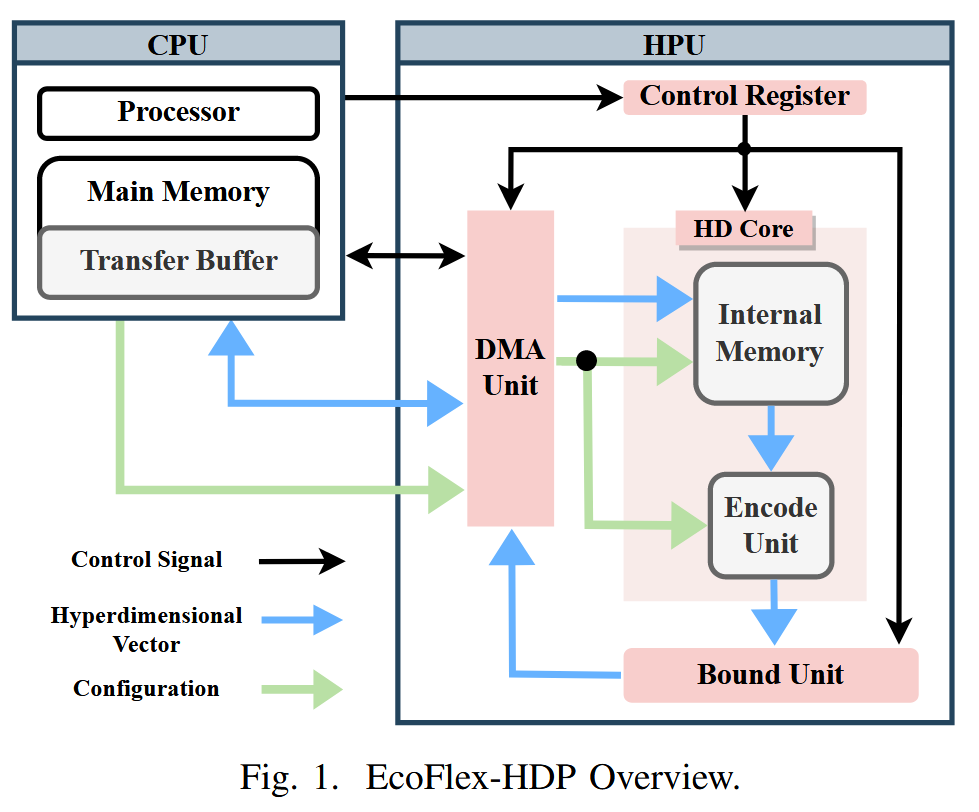
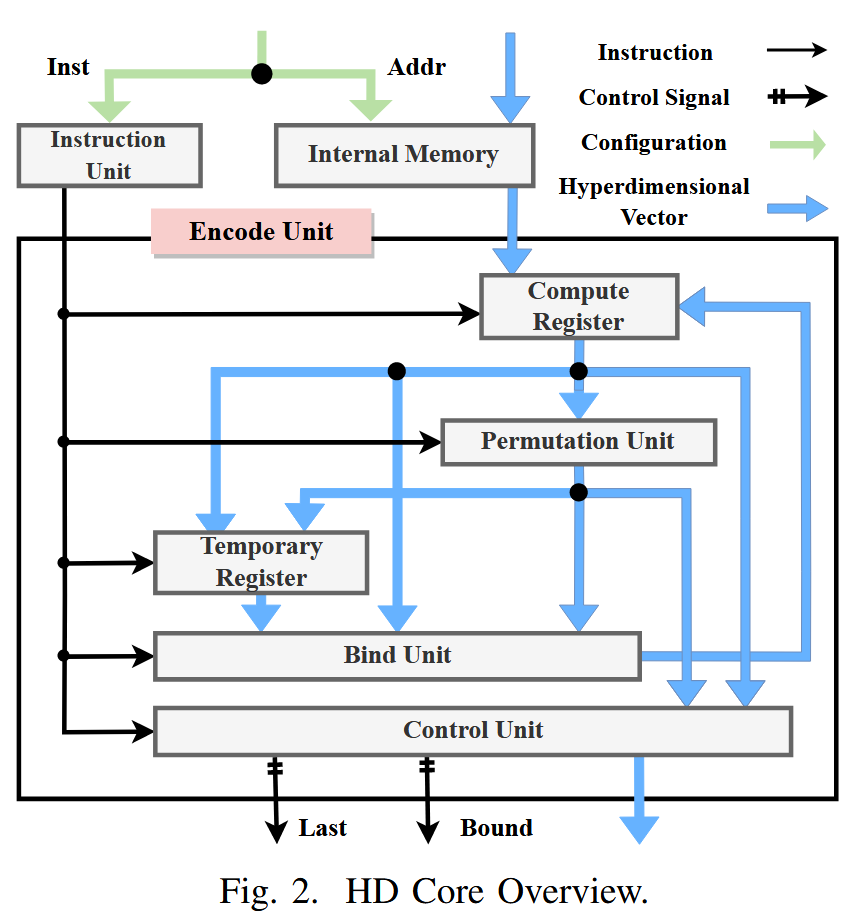
EcoFlex-HDP: High-Speed and Low-Power and Programmable Hyperdimensional-Computing Platform with CPU Co-processing
提到了之后会做 CGRA 平台
Hardware Optimizations of Dense Binary Hyperdimensional Computing: Rematerialization of Hypervectors, Binarized Bundling, and Combinational Associative Memory
Revisiting HyperDimensional Learning for FPGA and Low-Power Architectures
EcoFlex-HDP: High-Speed and Low-Power and Programmable Hyperdimensional-Computing Platform with CPU Co-processing
本文有开源:EcoFlexHDP
项目框架