Megatron-Core:PP 基本原理(朴素流水并行原理,Bubble 空泡率计算,Gpipe 原理解析与动态内存峰值分析)
1)朴素流水并行原理: 朴素流水并行原理较为简单,如图所示:四种不同的色块代表不同的 rank(或 GPU),rank0 将本地计算后的激活值传递给后续的 rank1,以此类推直到 rank3 完成类似流水线的前向传输过程,此时 rank3 开启反向流水线计算过程,将本阶段的计算梯度传递给 rank2,以此类推完成反向传输过程,最终得到各个 rank 的梯度,进行模型各个流水线阶段的权重参数更新,此时完成一轮流水线迭代训练。
2)Bubble 空泡率计算: 此时显然可见,图中大部分的时间为空白,计算与通信缺乏 overlap,即存在计算等通信的现象(rank1 要等待 rank0 激活前向传递之后才能计算),因此对于图中的“空白部分”,我们引入 Bubble 的概念来定量的评估流水线并行的性能。空泡 Bubble 的产生,是因为算子内并行和算子间并行解决单设备内存不足的问题,模型经过拆分后的上一个 rank 的 stage 需要长期持续处于空闲状态,等待其他 rank 的 stage 计算完成,才可以开始计算,这极大降低了设备的平均使用率。这种现象被称为并行空泡(Parallelism Bubble)。总的 bubble 占用的时间跟流水并行 PP 切分策略相关:
\begin{equation} t_{bubble} = (p - 1)(t_f + t_b) \end{equation} $$ 其中 p 为并行度,$t_f$ 为前向时间,$t_b$ 为反向时间,pipeline bubble 占据了 ( p − 1 ) 个前向、反向过程。 Bubble 占有率比例 bubbletaion,又称空泡率,计算由公式给出:\begin{equation} \mathit{bubble ration} = \frac{t_{bubble}}{t_{bubble} + t_{ideal}} = \frac{(p-1)(t_f + t_b)}{(p-1)(t_f + t_b) + m(t_f + t_b)} = \frac{p - 1}{m + p - 1} \end{equation}
$$ 其中 t i d e a l 为理想迭代时间, 为 micro-batch 的数量,, 为单个 m i c r o − b a t c h 时间,因此 t i d e a l = m ( t f + t b )。根据上面的公式, 跟 m i c r o − b a t c h e s 有关系,micro-batch 数量(m)越多,Bubble 的比例越会降低到可接受的水平,因此在衡量大模型性能优化的过程, 是作为一个衡量指标去看待其利用率。
3)Gpipe 原理解析: Gpipe 是基于上述特点推出的流水线并行技术:将一个 batch size 的数据切分成四个 micro-batch size,每个 micro-batch 作为朴素流水并行方式中的一个 batch,前向过程从 rank0 流向 rank3(又称为 warmup),再反向回溯(称为 cooldown)。 计算空泡率:
\begin{equation} bubble ration=\frac{t_{bubble}}{t_{ideal}}=\frac{p-1}{m} \end{equation}
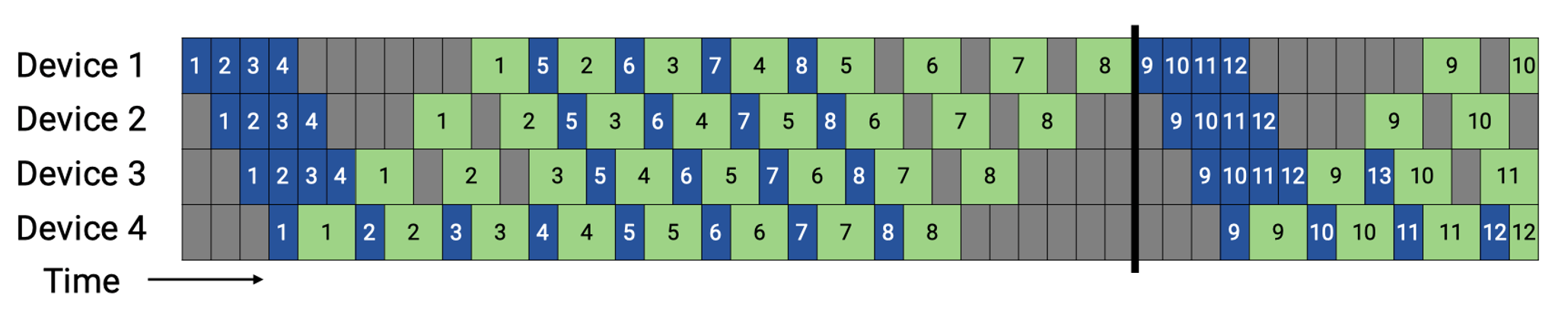 ## Virtual Pipeline 基本原理 后续 Megatron-LM 在 1F1B 的基础上做了 Interleaved 1F1B 的优化,减少了流水线气泡,也就是本篇介绍的虚拟流水并行(Virtual Pipeline Parallelism,简称 VPP)。 VPP 的核心在于,让一个物理层面的 device 虚拟成为 v 个 devices,device 从计算 1 个或连续 layer 段到计算 v 个不相邻的 layer,如图所示:GPU1 之前只负责 layer1 或 layer1+layer2 层的计算,经过虚拟化流水线后,负责 layer0 和 layer5 层的计算,使得 layer1 层计算完成后无需等待 layer2 的计算,可以直接进入 GPU2 进行计算,从而减少等待空泡时间,此处 v 被称为虚拟流水线阶段(virtual pipeline stage)。 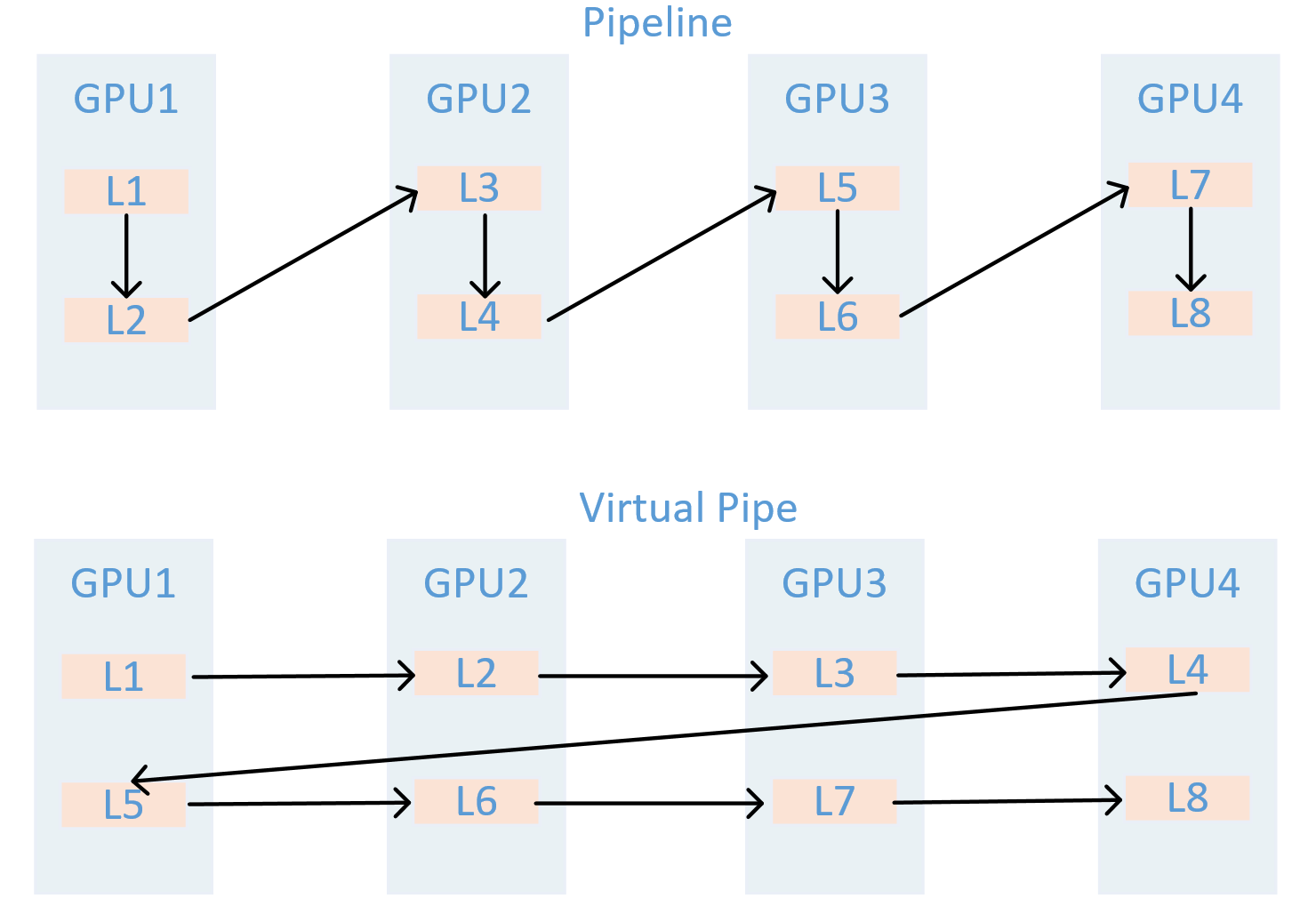 假设模型总层数为 16,张量并行大小 tp=1,流水线并行大小 pp=4,虚拟流水线并行大小 v=2,则模型将被划分为 4 * 2 = 8 个阶段,每个阶段包含 16 / 8 = 2 个层。前向的顺序为 GPU 1 -> GPU 2 -> GPU 3 -> GPU 4 -> GPU 1 -> GPU 2 -> GPU 3 -> GPU 4。在设备数量不变的情况下,分出更多的流水线阶段,这样可以让流水线中每个 stage 更小,因而下个 stage 的等待时间更短,气泡更小。需要注意的是,m 需要是 p 的整数倍。  𝑚为 micro-batch,𝑝为 pipeline stages,v 为 virtual pipeline stage,完成 v 个 layer 段中一个的前向、后向时间分别为 $t_f/v$ 和 $t_b/v$,流水线气泡的耗时 $t_{pd}^{int}$:\begin{equation} t_{pd}^{int}=\frac{(p-1)_(t_f+t_b)}{v} \end{equation}
\begin{equation} bubble ration=\frac{1}{v}_\frac{p-1}{m} \end{equation}
需要注意的是,VPP是以增加通信量为代价,换取更低的空泡比率,相比于1FB现在的气泡占比就减少到了1/v。但是流水线之间的通信量也增加了v倍。对于一个 pipeline stage,里面包括多个 Transformer layer,所以现在相当于流水线的stage增加了,通信量也会增加。特别是当global的batch越来越大的时候,这个通信开销就会更显著。 ## 新兴PP技术(扩充) eam-2BW PipeDream-2BW 是一种面向超大规模深度模型的异步流水线并行方法:它将模型切分为多个阶段并复制多路流水线,在 1F1B 调度下通过“双缓冲”权重更新和梯度合并技术,大幅降低显存占用与通信开销;内置的自动化 Planner 根据设备内存和互联拓扑搜索最优阶段划分与复制宽度,并可选激活重计算;在多卡集群上训练大规模 Transformer 模型时,相较于传统流水线并行,吞吐量可提升数倍,同时保留与数据并行一致的权重更新语义。 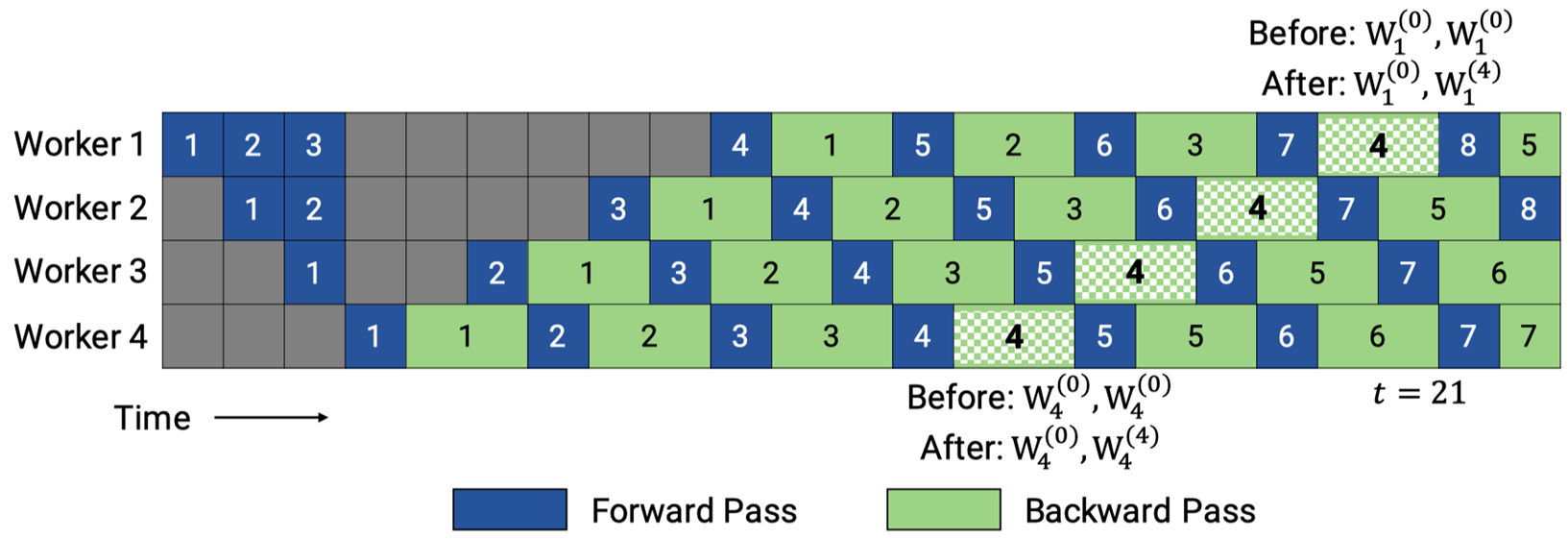 ### ZB-V Schedule ZB-V schedule 是一种面向流水线并行的内存高效零气泡调度策略:它将p个阶段划分为2p个模型块,并给每个 worker 分配两个模型块,按照从首到尾再返回首的V型顺序进行分配,以确保每个微批次的前向和对权重的后向都在同一worker上执行,从而利用后向权重计算填充流水线空隙;在与1F1B相同的显存约束下,可在正向、后向输入与权重后向计算时间相等时实现近零气泡;同时,该调度保持各 worker 峰值激活内存均衡,兼顾吞吐与显存效率。  ### Hanayo Wave-like Pipeline Hanayo 是一种波浪式流水线并行策略:它将模型划分为S个阶段并将小批次分成W个波(wave),以波浪形的顺序在各阶段交错执行前向和后向计算,能够将流水线气泡比例降低至原来的1/(2W) 且无需复制模型,从而保持与主流方法一致的权重和激活内存占用;同时,其轻量级运行时引擎将调度逻辑与执行和通信优化解耦,支持在多卡集群上灵活部署;在对GPT和BERT类模型、最多32块GPU的测试中,Hanayo相较最先进方案实现了最高30.4%的吞吐量提升 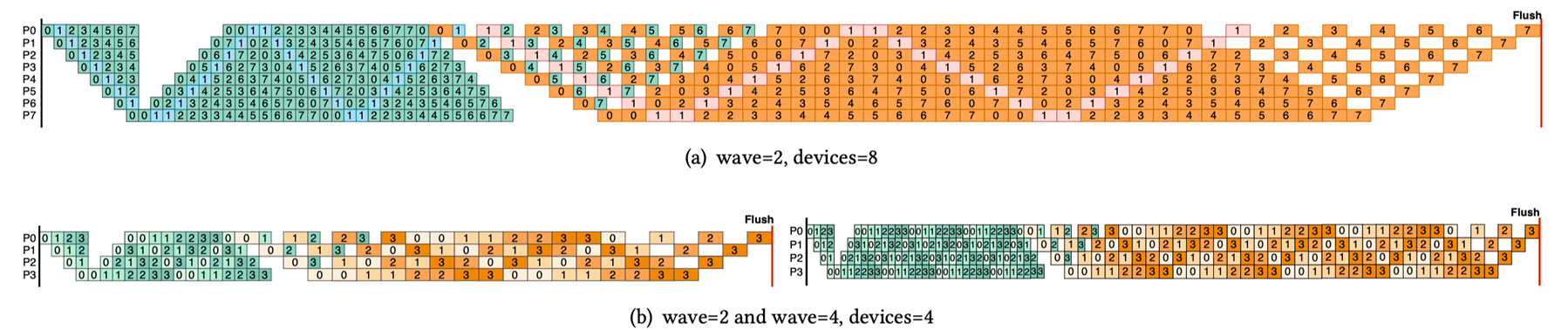 ## 分布式框架里的PP实现 - 模型运行入口与PP配置: pretrain_gpt.py main函数调用pretrain->get_model,get_model函数判断pipeline的划分策略 ``` Megatron-LM/pretrain_gpt.py if __name__ == "__main__": # Temporary for Transition to Core Datasets train_valid_test_datasets_provider.is_distributed = True # Optionally Enable Inprocess Restart on Pretrain pretrain, store = inprocess_restart.maybe_wrap_for_inprocess_restart(pretrain) pretrain( train_valid_test_datasets_provider, model_provider, ModelType.encoder_or_decoder, forward_step, args_defaults={'tokenizer_type': 'GPT2BPETokenizer'}, extra_args_provider=add_modelopt_args if has_nvidia_modelopt else None, store=store, ) ``` pretrain函数内部调用setup_model_and_optimizer函数,该函数内部调用get_model ``` Megatron-LM/megatron/training/training.py/def pretrain # Model, Optimizer, and Learning Rate. timers('model-and-optimizer-setup', log_level=0).start(barrier=True) app_metrics['app_build_optimizer_start_time'] = one_logger_utils.get_timestamp_in_ms() model, optimizer, opt_param_scheduler = setup_model_and_optimizer( model_provider, model_type, checkpointing_context=checkpointing_context ) Megatron-LM/megatron/training/training.py/def setup_model_and_optimizer def setup_model_and_optimizer( model_provider_func, model_type, no_wd_decay_cond=None, scale_lr_cond=None, lr_mult=1.0, checkpointing_context=None, ): """Setup model and optimizer.""" args = get_args() timers = get_timers() one_logger = get_one_logger() model = get_model(model_provider_func, model_type) unwrapped_model = unwrap_model(model) ``` get_model通过get_args函数拿到启动脚本设置的超参,参数设置如图所示: ```python MODEL_PARALLEL_ARGS = ( --tensor-model-parallel-size 8 --pipeline-model-parallel-size 16 ) ``` ``` Megatron-LM/megatron/training/training.py/def get_model def get_model(model_provider_func, model_type=ModelType.encoder_or_decoder, wrap_with_ddp=True): """Build the model.""" args = get_args() args.model_type = model_type # Build Model. ``` 此处分为两种情况讨论,以下是启用虚拟管道(VPP)的模型构建,判断条件如第一个if所示。判定逻辑标记了:只有第一个rank做输入,最后一个rank做输出,利用model_provider_func函数计算当前Rank该“切”哪一段 Transformer 层并实例化,最终把所有Rank按顺序放入model列表,供后面的流水线调度器循环调用。 ``` Megatron-LM/megatron/training/training.py/def get_model if ( mpu.get_pipeline_model_parallel_world_size() > 1 and args.virtual_pipeline_model_parallel_size is not None ): if model_type == ModelType.encoder_and_decoder: assert ( args.encoder_pipeline_model_parallel_size == 0 ), "Interleaved schedule not supported for model with encoder on separate PP rank" model = [] for i in range(args.virtual_pipeline_model_parallel_size): # Set pre_process and post_process only after Virtual Rank is Set. pre_process = mpu.is_pipeline_first_stage(ignore_virtual=False, vp_stage=i) post_process = mpu.is_pipeline_last_stage(ignore_virtual=False, vp_stage=i) this_model = model_provider_func( pre_process=pre_process, post_process=post_process, vp_stage=i) this_model.model_type = model_type this_model.vp_stage = i model.append(this_model) ``` 否则启用PipeDream流水线并行,根据模型类型和并行度,将编码器和解码器模块合理地拆分到不同 GPU,保证前向/反向传递的正确性与高效性。 ``` Megatron-LM/megatron/training/training.py/def get_model else: pre_process = mpu.is_pipeline_first_stage() post_process = mpu.is_pipeline_last_stage() add_encoder = True add_decoder = True if model_type == ModelType.encoder_and_decoder: if mpu.get_pipeline_model_parallel_world_size() > 1: rank = mpu.get_pipeline_model_parallel_rank() first_decoder_rank = args.encoder_pipeline_model_parallel_size world_size = mpu.get_pipeline_model_parallel_world_size() pre_process = rank == 0 or rank == first_decoder_rank post_process = (rank == (first_decoder_rank - 1)) or (rank == (world_size - 1)) add_encoder = mpu.is_inside_encoder(rank) add_decoder = mpu.is_inside_decoder(rank) model = model_provider_func( pre_process=pre_process, post_process=post_process, add_encoder=add_encoder, add_decoder=add_decoder, ) else: model = model_provider_func(pre_process=pre_process, post_process=post_process) model.model_type = model_type return model ``` - PP模型实例化:(没找全) 通过上述get_model函数里的model_provider_func函数构建模型实例,model_provider_func并不是Megatron-Core库里一个单独的全局函数,而是由各个预训练脚本(如 pretrain_gpt.py)定义并传入核心训练流程的回调。 ``` Megatron-LM/pretrain_gpt.py def model_provider( pre_process=True, post_process=True, vp_stage: Optional[int] = None ) -> Union[GPTModel, megatron.legacy.model.GPTModel]: ``` 构建GPTModel实例, ``` Megatron-LM/megatron/core/models/gpt/gpt_model.py class GPTModel(LanguageModule): def __init__(…): # Transformer. self.decoder = TransformerBlock( config=self.config, spec=transformer_layer_spec, pre_process=self.pre_process, post_process=self.post_process, vp_stage=vp_stage, ) ``` - PP获取需要执行的层数:(没看懂) TransformerBlock注册通过get_num_layers_to_build计算当前Stage包含几个Transformer Layer ``` Megatron-LM/megatron/core/transformer/transformer_block.py def get_num_layers_to_build(config: TransformerConfig, vp_stage: Optional[int] = None) -> int: return num_layers_to_build class TransformerBlockSubmodules: def _get_block_submodules(…): if isinstance(spec, TransformerBlockSubmodules): return spec # ModuleSpec here is Generally Assumed to Be for a Transformer Layer that # Is Implemented in `transformer_layer.py` or if it Subclasses # `BaseTransformerLayer` From the `transformer_layer.py` File. elif isinstance(spec, ModuleSpec): if issubclass(spec.module, TransformerBlock): return spec.submodules elif issubclass(spec.module, BaseTransformerLayer): num_layers = get_num_layers_to_build(config, vp_stage) return TransformerBlockSubmodules( layer_specs=[spec] * num_layers, layer_norm=LayerNormImpl ) else: raise Exception(f"specialize for {spec.module.__name__}.") else: raise Exception(f"specialize for {type(spec).__name__}.") ``` 在 GPT 模型运行示例中每个 Stage build_layer 的个数为 number_lyaer = L / PP_num ``` Megatron-LM/megatron/core/transformer/transformer_block.py class TransformerBlock(MegatronModule): """Transformer class.""" def __init__( self.num_layers_per_pipeline_rank = len(self.layers) def _build_layers(self): # Transformer Layers. # @jcasper Can We Improve how We Deal with layer_number? # Currently It's only Used in CoreAttention? # If self.apply_query_key_layer_scaling: # Coeff = self.layer_number # self.norm_factor *= Coeff def build_layer(layer_spec, layer_number): global_layer_number = layer_number + get_transformer_layer_offset( self.config, self.vp_stage ) # 1-based index if self.config.heterogeneous_block_specs: layer_config = self.config.get_config_for_layer(global_layer_number) else: layer_config = self.config ``` - 执行PP训练: GPT训练调用 pretrain -> train -> train_step,执行一个 iteration, train_step函数通过get_forward_backward_fun()函数进入schedulers.py模块,并根据当前的 PP 模式返回forward_backward_pipelining_with_interleaving执行前向和反向计算 ``` Megatron-LM/megatron/training/training.py def train_step(forward_step_func, data_iterator, model, optimizer, opt_param_scheduler, config): """Single training step.""" … # Forward Pass. forward_backward_func = get_forward_backward_func() losses_reduced = forward_backward_func( forward_step_func=forward_step_func, data_iterator=data_iterator, model=model, num_microbatches=get_num_microbatches(), seq_length=args.seq_length, micro_batch_size=args.micro_batch_size, decoder_seq_length=args.decoder_seq_length, forward_only=False, adjust_tensor_shapes_fn=adjust_tensor_shapes_fn, ) Megatron-LM/megatron/core/pipeline_parallel/schedules.py def get_forward_backward_func(): pipeline_model_parallel_size = parallel_state.get_pipeline_model_parallel_world_size() if pipeline_model_parallel_size > 1: if parallel_state.get_virtual_pipeline_model_parallel_world_size() is not None: forward_backward_func = forward_backward_pipelining_with_interleaving else: forward_backward_func = forward_backward_pipelining_without_interleaving else: forward_backward_func = forward_backward_no_pipelining return forward_backward_func ``` - NPU0执行stage0(不清晰) 执行 Forward 计算,选择 forward_backward_pipelining_without_interleaving模式 (以Pipeline 1F1B为例,即PipeDream) 先关闭梯度更新,等所有的microbatch执行完毕才更新梯度。过程如图所示: 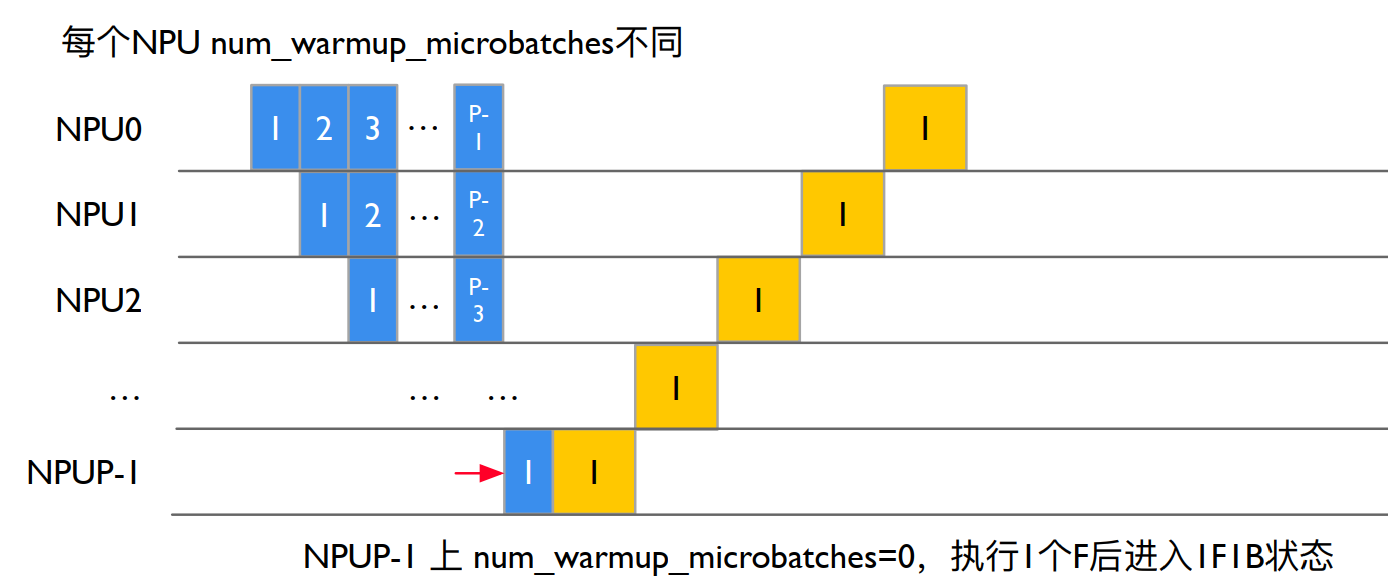 部分代码展示: 其中:num_microbatches:总的 micro batch 个数。num_warmup_microbatches:当前rank warmup阶段需要计算,直到1F1B 的microbatch的个数。 num_microbatches_remaining:当前rank还剩下多少个microbatch执行才到1F1B阶段,即num_microbatches - num_warmup_microbatches。 ``` Megatron-LM/megatron/core/pipeline_parallel/schedules.py def forward_backward_pipelining_without_interleaving( … micro_batch_size: int, … ): … disable_grad_sync() # Compute Number of Warmup Microbatches. num_warmup_microbatches = ( parallel_state.get_pipeline_model_parallel_world_size() - parallel_state.get_pipeline_model_parallel_rank() - 1 ) num_warmup_microbatches = min(num_warmup_microbatches, num_microbatches) num_microbatches_remaining = num_microbatches - num_warmup_microbatches ``` - NPU0完成前向计算,如图所示: NPU0在stage0阶段没有其它的Stage激活输入,因此忽略recv_forward () 函数,forward_step调用 forward_step_func 真正调用模型执行: 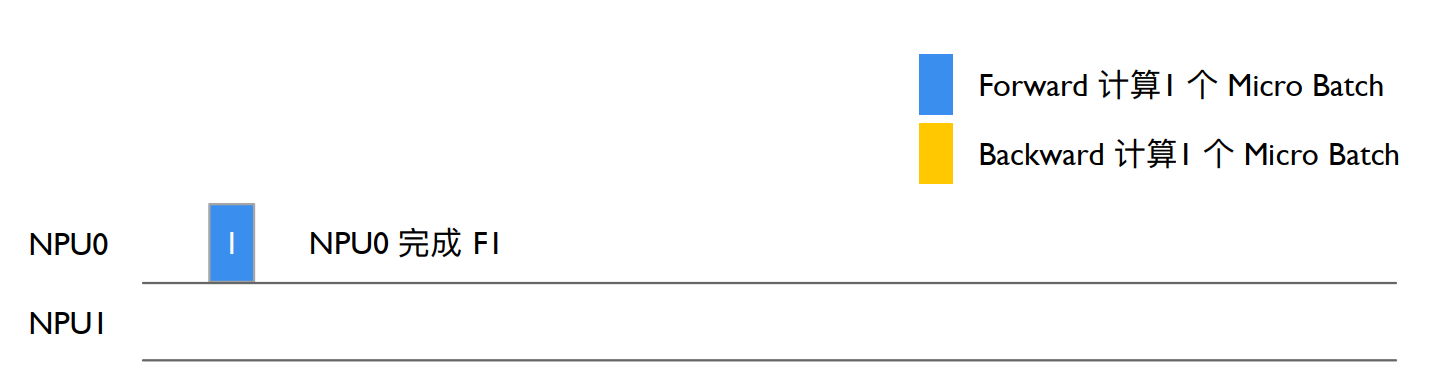 ``` Megatron-LM/megatron/core/pipeline_parallel/schedules.py # Run Warmup forward Passes. for i in range(num_warmup_microbatches): # Decide to Checkpoint All Layers' Activations of the Current Micro-batch if max_outstanding_backprops is not None: checkpoint_activations_microbatch = ( i % max_outstanding_backprops >= config.num_microbatches_with_partial_activation_checkpoints ) else: checkpoint_activations_microbatch = None input_tensor = recv_forward( recv_tensor_shapes, config, parallel_state.is_pipeline_first_stage() ) output_tensor, num_tokens = forward_step( forward_step_func, data_iterator, model, num_microbatches, input_tensor, forward_data_store, config, collect_non_loss_data, checkpoint_activations_microbatch, check_first_val_step(first_val_step, forward_only, i == 0), current_microbatch=i, encoder_decoder_xattn=encoder_decoder_xattn, ) def forward_step(…) … if config.enable_autocast: context_manager = torch.autocast("cuda", dtype=config.autocast_dtype) else: context_manager = contextlib.nullcontext() with context_manager: if checkpoint_activations_microbatch is None: output_tensor, loss_func = forward_step_func(data_iterator, model) else: output_tensor, loss_func = forward_step_func( data_iterator, model, checkpoint_activations_microbatch ) ``` - NPU0前向传递激活,如图所示: 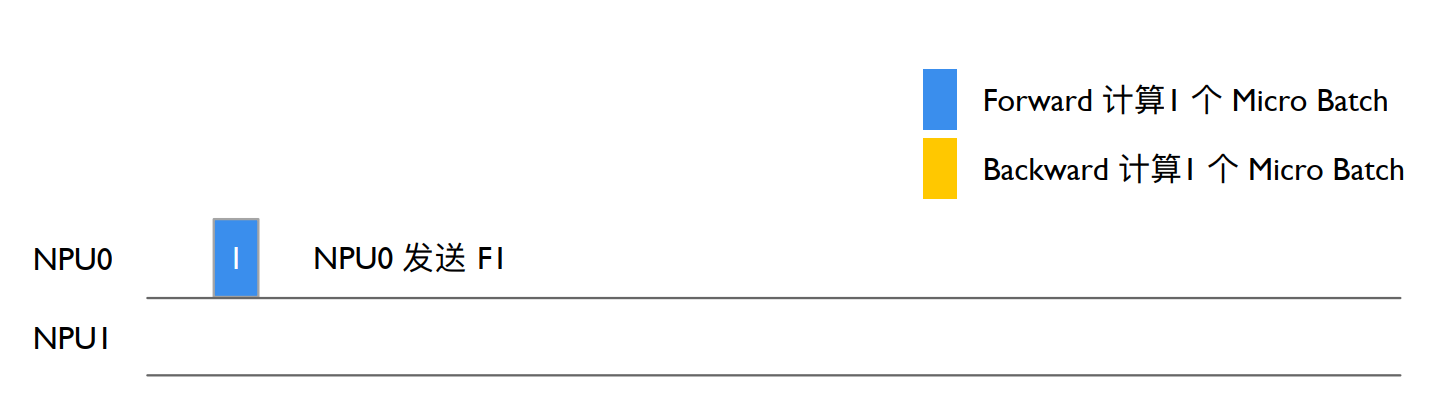 - NPU0上输出Stage0 output_tensor后send_forward发送给下一个Stage,通过P2P_communication.send_forward发送output_tensor,通过torch.distributed.P2POp异步send output_tensor,最后调用 torch.cuda.synchronize() 执行同步 ``` Megatron-LM/megatron/core/pipeline_parallel/schedules.py send_forward( output_tensor, send_tensor_shapes, config, parallel_state.is_pipeline_last_stage() ) def send_forward(output_tensors, tensor_shapes, config, is_last_stage): """Wrapper for p2p_communication.send_forward used with non-interleaving schedule.""" if not isinstance(output_tensors, list): output_tensors = [output_tensors] for output_tensor, tensor_shape in zip(output_tensors, tensor_shapes): if tensor_shape is None: continue p2p_communication.send_forward(output_tensor, config, is_last_stage) Megatron-LM/megatron/core/pipeline_parallel/p2p_communication.py if wait_on_reqs and len(reqs) > 0: for req in reqs if isinstance(reqs, list) else reqs.values(): req.wait() reqs = None if ( (config.batch_p2p_comm and config.batch_p2p_sync) # The Lists below Have a Size > 1 only when ETP ≠ DTP, # Meaning This Synchronization is Required when ETP ≠ DTP. or len(tensor_recv_prev_list) > 1 or len(tensor_recv_next_list) > 1 ): # To Protect against Race Condition when Using batch_isend_irecv(). # User Should Assert that We Have a Modern Enough PyTorch to not Need This torch.cuda.synchronize() ``` - NPU0继续计算: NPU0继续执行forward_step, Stage0前向计算得到第二个output_tensor, 利用sedn_forward_recv_backward函数发送output_tensor等待backward,进入1F1B状态,通过send_backward_recv_backward底层试下通过P2PPp异步,send output_tesnor,且异步recv tensor_recv_next,最后调用synchronize () 等待recv backward,NPU0进入等待状态。 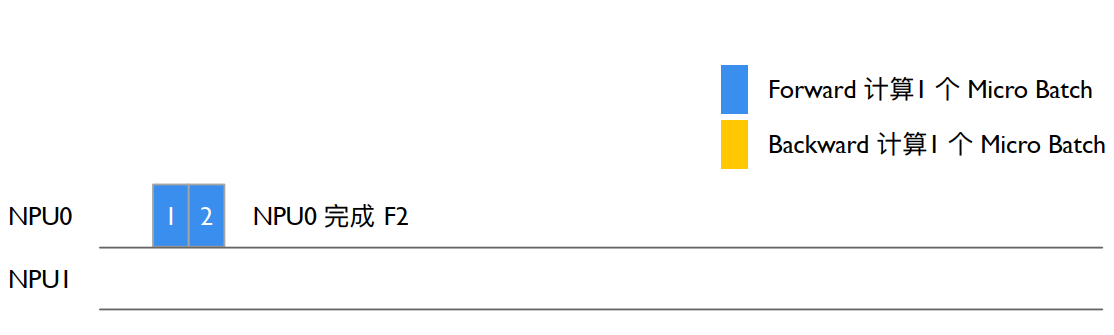 ``` Megatron-LM/megatron/core/pipeline_parallel/schedules.py def forward_backward_pipelining_without_interleaving(…): def enable_grad_sync(): # Run Warmup forward Passes. for i in range(num_warmup_microbatches): # Decide to Checkpoint All Layers' Activations of the Current Micro-batch if max_outstanding_backprops is not None: checkpoint_activations_microbatch = ( i % max_outstanding_backprops >= config.num_microbatches_with_partial_activation_checkpoints ) else: checkpoint_activations_microbatch = None input_tensor = recv_forward( recv_tensor_shapes, config, parallel_state.is_pipeline_first_stage() ) output_tensor, num_tokens = forward_step( forward_step_func, data_iterator, model, num_microbatches, input_tensor, forward_data_store, config, collect_non_loss_data, checkpoint_activations_microbatch, check_first_val_step(first_val_step, forward_only, i == 0), current_microbatch=i, encoder_decoder_xattn=encoder_decoder_xattn, ) ``` - NPU1进行前向计算: 其过程同GPU0一致,如图所示: num_warmup_microbatches=0,进入1F1B状态,num_microbatches_remaining=3,recv_forward 调用 P2POp 异步recv,NPU1 最后调用synchronize () 执行同步等待 NPU0 Stage0 输出,从而保证NPU0 to NPU1 的执行顺序。 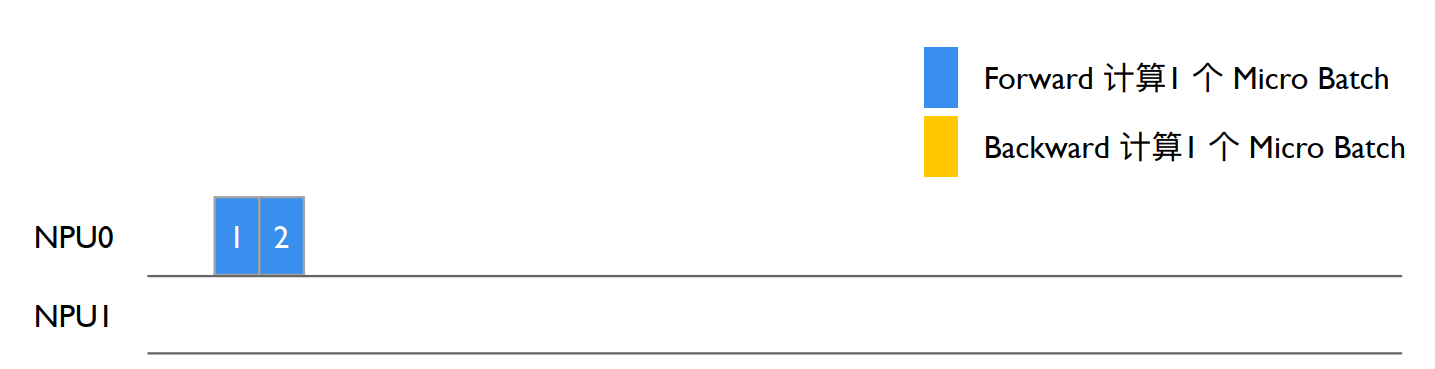 NPU1 recv_forward等待NPU0 Stage0发送intput_tensor后NPU1 forward_step设置iNPUt_tensor,实现NPU0&NPU1交换输入输出NPU1进入1F1B循环,forward_step_func调用GPTModel执行前向计算。NPU1 上TransformerBlock 执行第一个 Stage,Pre_process=False,即不会把iNPUt_embeddings作为ransformer的输入,使用NPU0 Stage0输入的iNPUt_tensor作为输入执行得到output tensor。 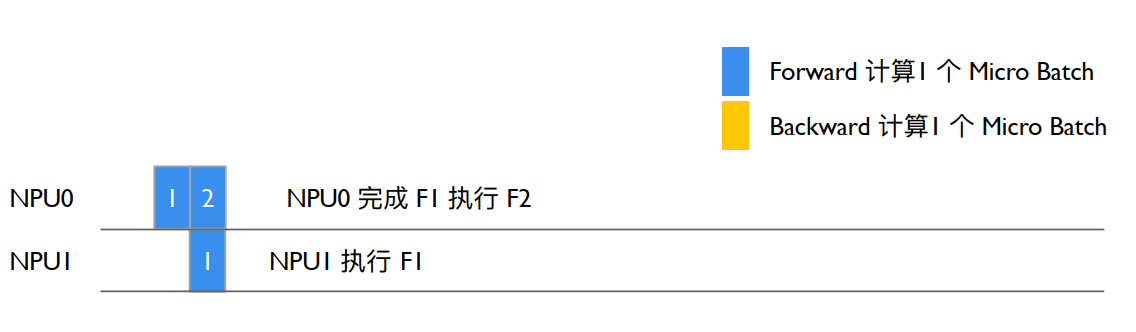 ``` Megatron-LM/megatron/core/transformer/transformer_block.py class TransformerBlock(MegatronModule): """Transformer class.""" def __init__( self, config: TransformerConfig, spec: Union[TransformerBlockSubmodules, ModuleSpec], post_layer_norm: bool = True, pre_process: bool = False, post_process: bool = True, model_comm_pgs: ModelCommProcessGroups = None, vp_stage: Optional[int] = None, ): super().__init__(config=config) self.submodules = _get_block_submodules(config, spec, vp_stage) self.post_layer_norm = post_layer_norm self.pre_process = pre_process self.post_process = post_process self.vp_stage = vp_stage def forward(…): if not self.pre_process: # See set_input_tensor() hidden_states = self.input_tensor ``` 示例中NPU1 Stage1是最后一层Staege,因此post_process=True, 执行 is_pipeline_last_stage计算GPT模型的output_tensor和loss。 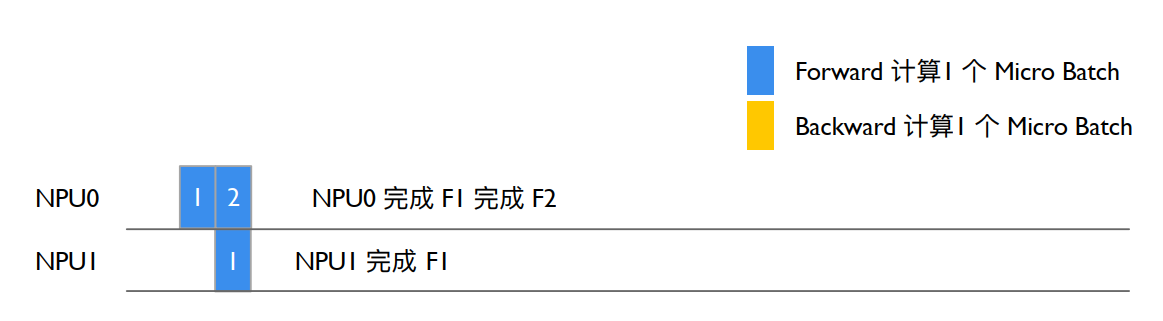 ``` Megatron-LM/megatron/core/transformer/transformer_block.py class TransformerBlock(MegatronModule): """Transformer class.""" def __init__( self, config: TransformerConfig, spec: Union[TransformerBlockSubmodules, ModuleSpec], post_layer_norm: bool = True, pre_process: bool = True, post_process: bool = True, model_comm_pgs: ModelCommProcessGroups = None, vp_stage: Optional[int] = None, ): Megatron-LM/megatron/core/pipeline_parallel/schedules.py def forward_step(…) … if parallel_state.is_pipeline_last_stage(ignore_virtual=False, vp_stage=vp_stage): if not collect_non_loss_data: outputs = loss_func(output_tensor) if len(outputs) == 3: output_tensor, num_tokens, loss_reduced = outputs if not config.calculate_per_token_loss: output_tensor /= num_tokens output_tensor /= num_microbatches else: # Preserve Legacy Loss Averaging Behavior (ie, over the Number of microbatches) assert len(outputs) == 2 output_tensor, loss_reduced = outputs output_tensor *= parallel_state.get_context_parallel_world_size() output_tensor /= num_microbatches forward_data_store.append(loss_reduced) else: data = loss_func(output_tensor, non_loss_data=True) forward_data_store.append(data) ``` - NPU1反向执行Stage1: 执行完forward_step后执行backward_step得到iNPUt_tensor_grad,并进入1F1B状态,执行send_backward_recc_forward->_communication->异步发送iNPUt_tensor_grad给NPU0并等待NPU0发送下一个MB forward结果。 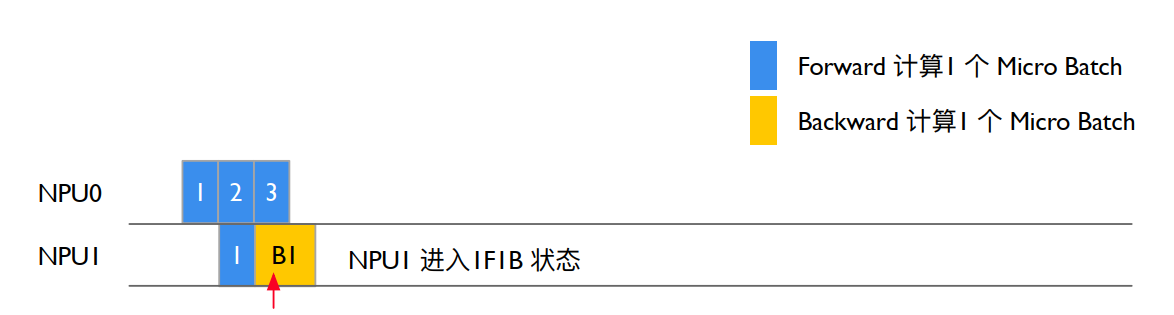 ``` Megatron-LM/megatron/core/pipeline_parallel/schedules.py def forward_backward_pipelining_without_interleaving(…): # Enable Grad Sync for the Last Microbatch in the Batch if the Full # Backward Pass Completes in the 1F1B Stage. if num_warmup_microbatches == 0 and last_iteration: if config.grad_sync_func is None or rank == 0: enable_grad_sync() input_tensor_grad = backward_step( input_tensor, output_tensor, output_tensor_grad, model_type, config ) if last_iteration: input_tensor = None send_backward( input_tensor_grad, recv_tensor_shapes, config, parallel_state.is_pipeline_first_stage(), ) else: input_tensor = send_backward_recv_forward( input_tensor_grad, recv_tensor_shapes, config, parallel_state.is_pipeline_first_stage(), ) def send_backward_recv_forward(input_tensor_grads, tensor_shapes, config, is_first_stage): """Wrapper for p2p_communication.send_backward_recv_forward used with non-interleaving schedule.""" if not isinstance(input_tensor_grads, list): input_tensor_grads = [input_tensor_grads] input_tensors = [] for input_tensor_grad, tensor_shape in zip(input_tensor_grads, tensor_shapes): if tensor_shape is None: input_tensors.append(None) continue input_tensor = p2p_communication.send_backward_recv_forward( input_tensor_grad, tensor_shape, config, is_first_stage ) input_tensors.append(input_tensor) return input_tensors ``` - NPU0反向执行Stage0: NPU0 Srage0等待send_backward_recv_forward被唤醒后获得NPU1 Staege1发送的output_tensor_grad,NPU0 Stage0执行backward_step输出intput_tensor_grad,NPU0计入1F1B状态,NPU0 num_warmup_mbs=1, num_mbs_remaining=2,进入1F1B循环,执行forward_step执行Starge1前向计算得到output_tensor (Forward 3),执行send_forward_recv_backward发送output_tensor等待backward,异步recv tensor_recv_next,调用synnchronize () 同步等待backward,NPU0 进入等待状态。  ``` Megatron-LM/megatron/core/pipeline_parallel/schedules.py # Run 1F1B in Steady State. for i in range(num_microbatches_remaining): last_iteration = i == (num_microbatches_remaining - 1) # Decide to Checkpoint All Layers' Activations of the Current Micro-batch if max_outstanding_backprops is not None: checkpoint_activations_microbatch = ( (i + num_warmup_microbatches) % max_outstanding_backprops ) >= config.num_microbatches_with_partial_activation_checkpoints else: checkpoint_activations_microbatch = None output_tensor, num_tokens = forward_step(…) total_num_tokens += num_tokens if forward_only: send_forward( output_tensor, send_tensor_shapes, config, parallel_state.is_pipeline_last_stage() ) if not last_iteration: input_tensor = recv_forward( recv_tensor_shapes, config, parallel_state.is_pipeline_first_stage() ) else: output_tensor_grad = send_forward_recv_backward( output_tensor, send_tensor_shapes, config, parallel_state.is_pipeline_last_stage() ) Megatron-LM/megatron/core/pipeline_parallel/p2p_communication.py if recv_prev: if config.pipeline_dtype is None: raise RuntimeError("pipeline_dtype must be provided if recv_prev is True") if tensor_shape is None: raise RuntimeError( "tensor_shape must be specified if recv_prev is True. " "Common tensor_shape is (seq_length, micro_batch_size, hidden_size)" ) tensor_recv_prev_func = create_tensor_recv_prev if recv_next: if config.pipeline_dtype is None: raise RuntimeError("dtype must be provided if recv_next is True") if tensor_shape is None: raise RuntimeError( "tensor_shape must be specified if recv_next is True. " "Common tensor_shape is (seq_length, micro_batch_size, hidden_size)" ) tensor_recv_next_func = create_tensor_recv_next ``` - NPU1反向执行Stage1: 同理,NPU1 Stage1上执行send_backward_recv_forward同步等待收到NPU0 Stge0发送iNPUt_tensor(Forward 2), NPU1 Stage1将iNPUt_tensor(Forward 2)作为TransformerBlock执行forward_step, 得到输出output_tensor。  NPU0执行Stage0 NPU0等待send_forward_recv_backward执行NPU1输出output_grad(B2),执行backward_step输出iNPUt_tensor_grad(B2),NPU0 num_warmup_mbs=1, num_mbs_remaing=2, i=2,退出 1F1B,进入cooldown backwrd pass enable_grad_sync打开模型梯度更新,recv_backward等待NPU1发送最后一个 mbs 的backward(B3),NPU0 准备更新模型的梯度和参数。  NPU1执行Stage1 NPU1 Stage1执行send_backward_recv_forward同步等待iNPUt (F3), NPU1 num_warmup_mbs=0,num_mbs_remaining=3,进入1F1B循环, 将NPU0 Stage0发送 iNPUt (F3) 作为TransformerBlock的iNPUt计算前向, forward_step () 输出output (F3) 执行backward_step () 得到iNPUt_tensor_grad (B3), send_backward () 异步发送iNPUt_tesnor_grad (B3) 给NPU0。  NPU0执行Stage0后,执行完完整的iteration NPU0等待cooldown backward的recv_backward () 获得NPU1输出 (B3),执行 backward_step () 输出iNPUt_tensor_grad (B3),forward_backward_func () 返回LOSS,enable_grad_sync () 累加更新模型梯度,finalize_model_grads_func () 更新模型参数。  ``` Megatron-LM/megatron/core/pipeline_parallel/schedules.py def get_forward_backward_func(): pipeline_model_parallel_size = parallel_state.get_pipeline_model_parallel_world_size() if pipeline_model_parallel_size > 1: if parallel_state.get_virtual_pipeline_model_parallel_world_size() is not None: forward_backward_func = forward_backward_pipelining_with_interleaving else: forward_backward_func = forward_backward_pipelining_without_interleaving else: forward_backward_func = forward_backward_no_pipelining return forward_backward_func def forward_backward_pipelining_without_interleaving(…) def enable_grad_sync(): output_tensor_grad = recv_backward( send_tensor_shapes, config, parallel_state.is_pipeline_last_stage() ) input_tensor_grad = backward_step( input_tensor, output_tensor, output_tensor_grad, model_type, config ) send_backward( input_tensor_grad, recv_tensor_shapes, config, parallel_state.is_pipeline_first_stage(), ) # Launch Any Remaining Grad Reductions. if no_sync_context is not None: enable_grad_sync() if config.grad_sync_func is not None: config.grad_sync_func(model.parameters()) if config.finalize_model_grads_func is not None and not forward_only: # If defer_embedding_wgrad_compute is Enabled We Need to Do the # Weight Gradient GEMM's Here. finish_embedding_wgrad_compute(config, embedding_module) # Finalize Model Grads (perform Full Grad All-reduce / Reduce-scatter for # Data Parallelism, Layernorm All-reduce for Sequence Parallelism, and # Embedding All-reduce for Pipeline parallelism). config.finalize_model_grads_func( [model], total_num_tokens if config.calculate_per_token_loss else None ) if config.timers is not None: config.timers('forward-backward').stop() if hasattr(config, 'enable_cuda_graph') and config.enable_cuda_graph: create_cudagraphs() return forward_data_store ```